Do you LEGO?
From a humble Danish carpentry workshop to a global cultural phenomenon, the story of LEGO is one of innovation, resilience, and the enduring power of play. For generations, the iconic interlocking bricks have captivated the imaginations of children and adults alike, evolving from a simple toy into a powerful educational tool and a medium for artistic expression.
The journey began in 1932 when Ole Kirk Christiansen, a Danish carpenter, started making wooden toys during the Great Depression. Two years later, he named his company “LEGO,” a contraction of the Danish phrase leg godt, meaning “play well.” This simple motto would become the core philosophy of the brand. In the years following World War II, as plastics became more widely available, the company shifted its focus. Inspired by interlocking British-made plastic bricks, LEGO patented its own version in 1958, featuring the stud-and-tube design that allows for the perfect clutch power and endless building possibilities.
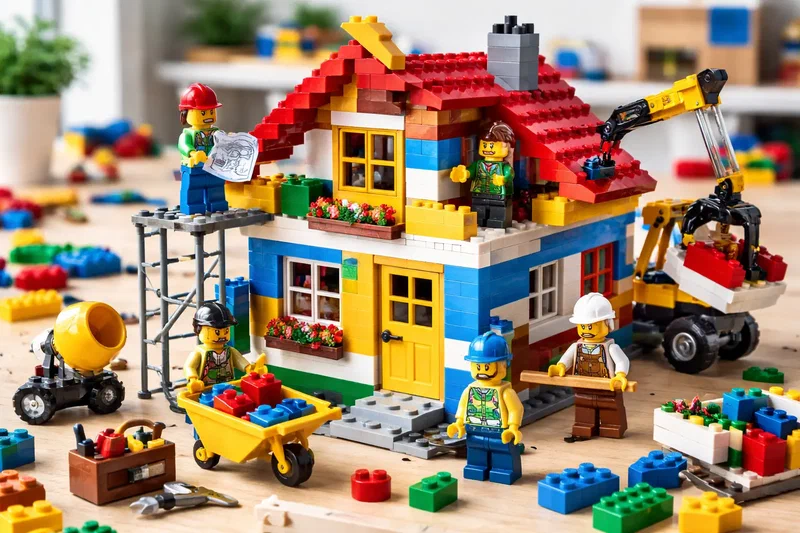
LEGO minifigures building something.
This seemingly simple innovation was the birth of what LEGO would call the “System in Play.” The company’s vision was to create a cohesive system where every brick, regardless of its size or color, could fit together, allowing for the construction and deconstruction of countless structures. This foundational concept laid the groundwork for the future, ensuring that bricks bought today are compatible with those from decades past. The introduction of the first LEGO Minifigure in 1978 further revolutionized play, adding a human element to the brick-built worlds.
The impact of LEGO extends far beyond the playroom. Educators and researchers have long recognized the cognitive benefits of LEGO play and its role in educational toys development. The act of building with bricks helps to develop fine motor skills, spatial awareness, and problem-solving abilities. Children learn to follow instructions, a critical skill for development, while also being encouraged to think creatively and experiment with their own designs. In classrooms, LEGO has become a valuable teaching tool for STEM (Science, Technology, Engineering, and Mathematics) subjects, with programs like LEGO Education using bricks to make complex concepts, from physics to coding, both tangible and engaging.
As a company, LEGO has successfully navigated a constantly changing market by both staying true to its core values and embracing new trends. After a period of financial struggles in the early 2000s that stemmed from over-diversification, the company refocused on its core product. This period of recovery also ushered in an era of strategic partnerships. Licensed sets based on popular franchises like Star Wars, Harry Potter, and Marvel Comics not only attracted new audiences but also tapped into the nostalgia of older builders, fueling the rise of the adult fan of LEGO (AFOL) community.
Today, LEGO continues to innovate, bridging the gap between physical and digital play. From video games that bring LEGO worlds to life to the LEGO Ideas platform, which allows fans to submit their own designs for potential official sets, the brand is constantly finding new ways to connect with its global community. Yet, for all its modern advancements, the heart of the LEGO brand remains the same: a powerful belief that through imagination, creativity, and quality, we can inspire and develop the builders of tomorrow.
I hope you enjoyed reading this article. Happy New Year!